committed to unburdening patients with convenience and care.
Zentalis is developing the first oral, non-chemotherapy, biomarker-driven approach for patients with Cyclin E1-positive platinum-resistant ovarian cancer
more choice. more possibility.
Platinum-resistant ovarian cancer is a difficult disease with limited treatments available today. Our focus on developing azenosertib, an investigational potential first-of-its-kind non-chemotherapy oral medicine, is rooted in our determination to move the treatment landscape from constraint to choice and complexity to convenience, advancing a new, meaningful approach to address these significant gaps for patients.
An oral daily dosing regimen means azenosertib is designed to be taken at home, with the goal to make treatment less intrusive and easier to integrate into daily life



how azenosertib works.
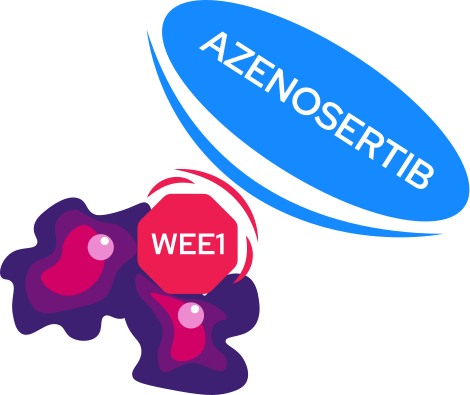
Azenosertib inhibits WEE1 kinase – a master regulator of the DNA damage response. We’re leveraging our understanding of WEE1 kinase and cellular checks and balances to preferentially target cancer cells. Learn more about this treatment approach below.

About the Investigational Treatment
Evaluating a WEE1 Inhibitor, a New Type of Therapy











Cell division is a normal process:
Cells in our bodies divide every day as a part of normal growth and repair.
Before a healthy cell divides, it slows down to check for DNA damage.
A protein called WEE1 acts like a brake, giving the cell time to repair any problems before moving forward.
This helps cells stay healthy and function as they should.
Cancer cells behave differently:
Cancer cells often rush through early checkpoints without fixing problems, which causes damage to build up.
But cancer cells can't survive if there's too much DNA damage.
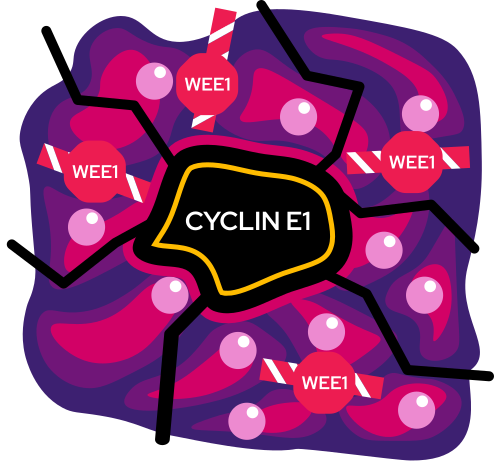
To survive, ovarian cancer cells rely on WEE1 at a later checkpoint. WEE1 slows them down, helping keep the damage at a level the cells can tolerate.
Some ovarian cancer cells have high levels of a protein called Cyclin E1, which drives them to divide even faster and increases damage. This added stress makes the cells more reliant on WEE1 for survival.
This is what Azenosertib does to a cancer cell:
Azenosertib is designed to block WEE1. When WEE1 is blocked, the cancer cells don't slow down to repair themselves, and they keep dividing.
Eventually, the damage becomes overwhelming and the cancer cells can't survive.
patient and caregiver resources.


Zentalis is providing these links as helpful resources for patients and caregivers. Inclusion on this list above does not represent an endorsement or a recommendation from Zentalis for any group or organization. The organizations listed are independent of Zentalis.