targeting meaningful impact.

Advancing a potential first-in-class, highly selective WEE1 inhibitor with the possibility to transform the treatment landscape in ovarian cancer and beyond

Significant Need for New Treatment Options

Patients with ovarian cancer, particularly those with platinum-resistant disease, face limited treatment options and treatments that often come with significant burden. Current therapies lack precision and convenience, and may provide limited benefit.

Zentalis has centered its clinical development program on azenosertib – an investigational selective inhibitor of WEE1 – to be the first oral, non-chemotherapy, biomarker-driven approach initially for Cyclin E1 positive, platinum-resistant ovarian cancer (PROC). Azenosertib is designed to have advantages over other investigational WEE1 therapies, including superior selectivity and pharmacokinetic properties.

View our pipeline

Not All Platinum-resistant Ovarian Cancer is the Same

Patients are unique, and so are their tumors. Through our research, we have found that Cyclin E1 positive PROC tumors are more sensitive to WEE1 inhibition.
~50 %1

Approximately half of patients with PROC may be Cyclin E1-positive1. These patients often have poorer outcomes, and yet no approved biomarker-directed therapies exist for this population.

COMPANION DIAGNOSIC STRATEGY

Our CDx strategy incorporates an immunohistochemistry clinical assay and our proprietary cutoff to selectively identify PROC patients whose tumors overexpress Cyclin E1 protein and may benefit more from azenosertib monotherapy.

Underlying Molecular Drivers of Cyclin E1 Positivity2

1. CCNE1 gene amplification
2. Increased gene transcription
3. Reduced protein degradation

These mechanisms lead to elevated Cyclin E1 protein levels, accelerating cell cycle progression and replication stress that may increase dependence on WEE1.

A New Targeted Approach

Patients who have become platinum-resistant have limited choices for treatment, including additional chemotherapy or chemo-based agents. Azenosertib has the potential to become an oral, effective, non-chemotherapy option for patients with Cyclin E1-positive PROC.

azenosertib mechanism of action.

innovating for patients

azenosertib mechanism of action.

In platinum resistance ovarian cancer, tumor cells are characterized by high proliferative rates and marked replication stress, commonly due to TP53 mutations and/or Cyclin E1 overexpression leading to a dysfunctional regulation at the G1/S checkpoint and premature entry into S phase. With this early checkpoint compromised, tumor cells become increasingly reliant on the G2/M checkpoint and on WEE1 to delay mitosis and preserve enough genomic integrity to survive.

When WEE1 is inhibited by azenosertib, the G2/M checkpoint is lost, forcing cells with unrepaired DNA damage to prematurely enter mitosis.2 This leads to mitotic catastrophe, accumulation of lethal DNA damage and ultimately tumor cell death.
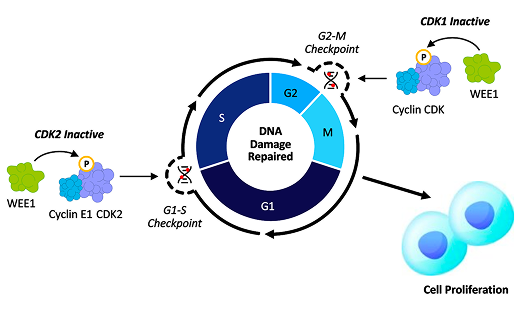
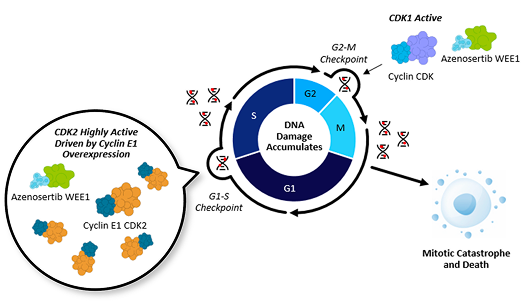
Cyclin E1 overexpression sensitizes cancer cells to azenosertib.

Normal Cell Cycle Regulation

  • CDKs and their cyclin binding partners promote progression through the cell cycle
  • Following DNA damage, WEE1 kinase inactivates Cyclin/CDK complexes at both G1–S and G2–M checkpoints to halt the cell cycle and allow for repair
  • Upon DNA repair, cells progress through the cell cycle and proliferate
Normal Cell Cycle Regulation

Cancer Cell and Azenosertib

  • Cyclin E1 overexpression increases CDK2 activity and accelerates G1–S transition, rendering cells more dependent on DNA repair at the G2–M checkpoint
  • Following DNA damage, WEE1 kinase inactivates Cyclin/CDK complexes at both G1–S and G2–M checkpoints to halt the cell cycle and allow for repair
Cancer Cell and Azenosertib

the science behind WEE1 and Cyclin E1.

WEE1 is a critical checkpoint controller that halts cell division to allow DNA repair.

Tumors characterized by high proliferative rates and replicative stress lead to frequent DNA damage during DNA replication and cell division. WEE1 inhibition forces cancer cells already under genomic stress to progress through the cell cycle without adequate DNA repair, leading to cell death. Healthy cells, less dependent on WEE1, are largely spared.

WEE1 inhibition shows particularly strong activity in tumors with high replication stress, such as those with Cyclin E1 protein overexpression. Excess Cyclin E1 protein accelerates the G1-S transition, creating replication stress that makes cancer cells highly vulnerable to WEE1 inhibition. When WEE1 is inhibited, these stressed cells cannot adequately repair their DNA and undergo unscheduled mitosis, ultimately causing cancer cell death.

This biology reveals opportunities for targeted, biomarker-driven treatment and is especially promising in ovarian cancers with elevated Cyclin E1 levels.

MORE CHOICE. MORE POSSIBILITY.
science block image

Extensive Translational Medicine and Clinical Development Experience.

innovating for patients

We believe we have amassed an extensive clinical database for our WEE1 inhibition approach, providing deep insights into optimal dosing, patient selection, and safety management. Concentrating resources and expertise on progressing azenosertib, Zentalis plans to gather data and insights to maximize possibilities for patients and physicians.

800+ cancer patients treated with azenosertib
300+ patients with ovarian cancer treated in azenosertib monotherapy

View our publications
  1. Cyclin E1 IHC+% based on literature and the unbiased CCNE1 amplification and Cyclin E1 overlapping data generated from Zentalis clinical trial samples
  2. Kim, D., et al. Cyclin E1/CDK2 activation defines a key vulnerability to WEE1 kinase inhibition in gynecological cancers, npj Precis. Onc. 9, 3 (2025). https://doi.org/10.1038/s41698-024-00787-4